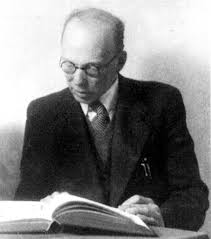
Valentin Tomberg was born in St. Petersburg (Russia) on February 26, 1900 (according to the Gregorian calendar) into a family of Estonian emigrants of humble origins. His father, Arnold Tomberg worked as a registrar at the school where Valentin was a pupil at primary and grammar school, and later as a secretary at the Russian Ministry of Internal Affairs. Already at the age of fifteen, Tomberg was introduced to the world of esotericism in St. Petersburg. In 1917 he became a member of the Theosophical Society, in whose library he came upon the book Knowledge of the Higher Worlds and Its Attainment and other writings by Steiner. Thus began his study of Anthroposophy and practicing the meditations from this book.
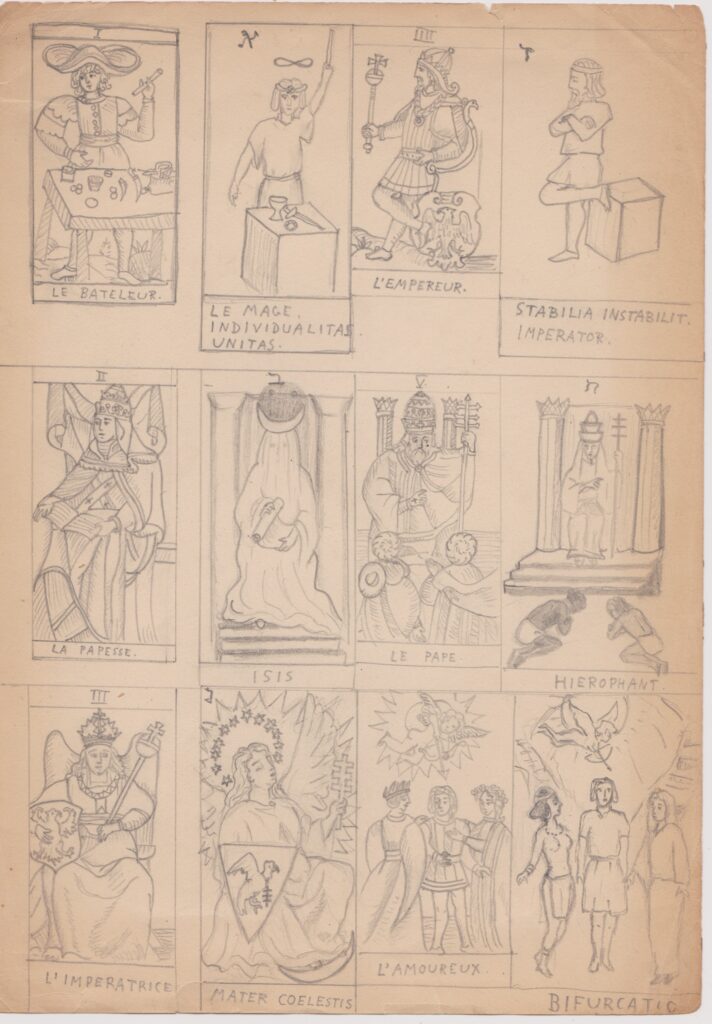
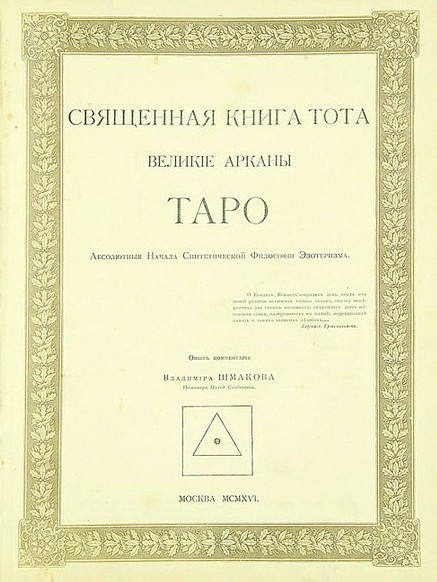
That same year, Tomberg also read The Holy Book of Thoth: The Great Arcana of the Tarot, published the year before by Vladimir A. Shmakov, who led a circle of “Rosicrucians” in Moscow.
When the Russian Revolution broke out in November 1917, Tomberg had just begun to study law, philosophy, and history at St. Petersburg University. A few months later, in April 1918, he fled with his parents to Estonia, which had become independent from Russia. Early 1918 he had a profound spiritual experience that he described later: “I became conscious of a powerful force of will within me that I united in the depths of my heart with a holy vow to dedicate my whole life to the cultivation of spiritual knowledge and its manifestation to the world.
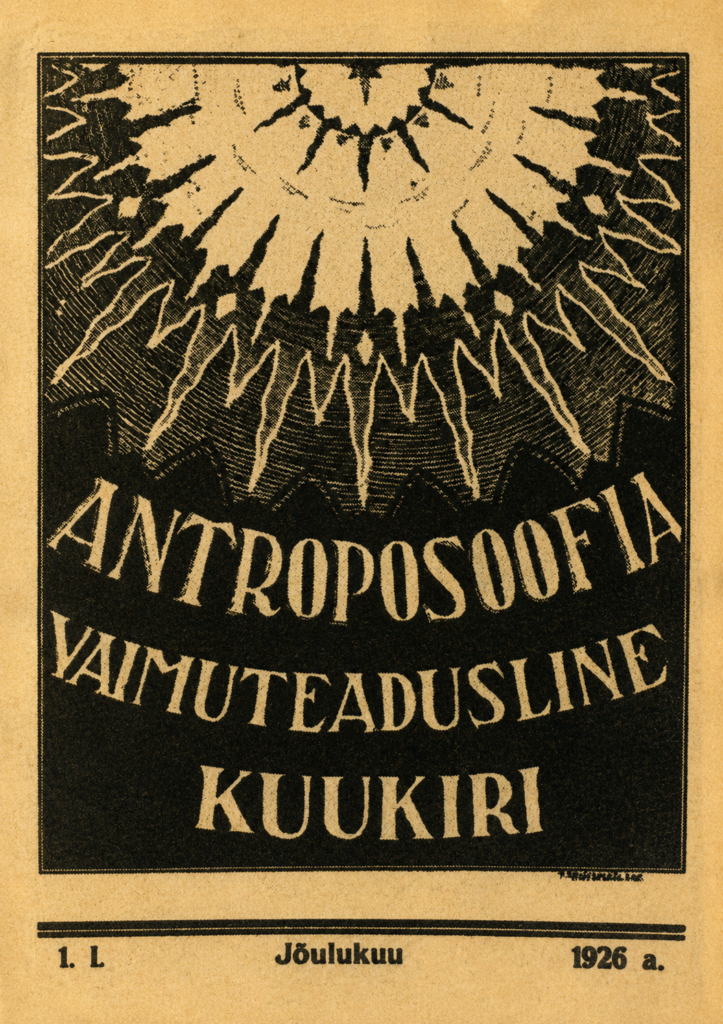
Anthroposophy had become his spiritual path by 1920 and on July 28, 1920 he wrote a letter to Rudolf Steiner, with the request to be taken into the circle of his students. This letter probably did not reach Steiner. After writing a second letter in 1924 he became a member of the Anthroposophical Society on January 1, 1925, after seven years of intensive anthroposophical studies.
From 1920 to 1922 he served as a nurse in a military hospital near Tallinn. After that he earned a living with occasional work as a farm laborer, pharmacy assistant, receptionist, French and English correspondent at the Ministry of Foreign Affairs. At night he studied law, philosophy, and religion.
in 1922, he married Elena Glasenap (1881–1944), an invalid woman. She was an acquaintance of his mother and nineteen years his senior. This was a marriage of convenience, which was ended in 1932. In 1923, Tomberg took a position with the Estonian Post Office in Tallinn, where, over the ensuing years, his skills and extensive knowledge of languages elevated him to head of the International Telephone Service.
As early as February 1926, Tomberg became vice-president of the Estonian Anthroposophical Society, which, in 1925, was made up of thirty-six members (Estonian, German, and Russian). He led working groups and began lecturing and writing articles. in July 1927, he met Marie Steiner, Guenther Wachsmuth, and Elisabeth Vreede, who were members of the Executive Council of the Anthroposophical Society in Dornach. Soon Marie Steiner became a confidante of Tomberg.
In 1929, during this first stay in Dornach he heard about a meeting of Russian anthroposophists planned for the summer of 1930 and decided to participate in its preparation. Maria Regina Belozvetov (1893–1973), leader of the Berlin group of Russian anthroposophists founded in 1928, was the driving force behind this initiative. Of Polish-French extraction, she had grown up in Russia and been a member of the Anthroposophical Society since 1915. At Christmas 1929, Tomberg traveled to Berlin to visit Maria and her husband Nikolai Belozvetov (1892–1950). An intensive spiritual cooperation grew out of this visit.
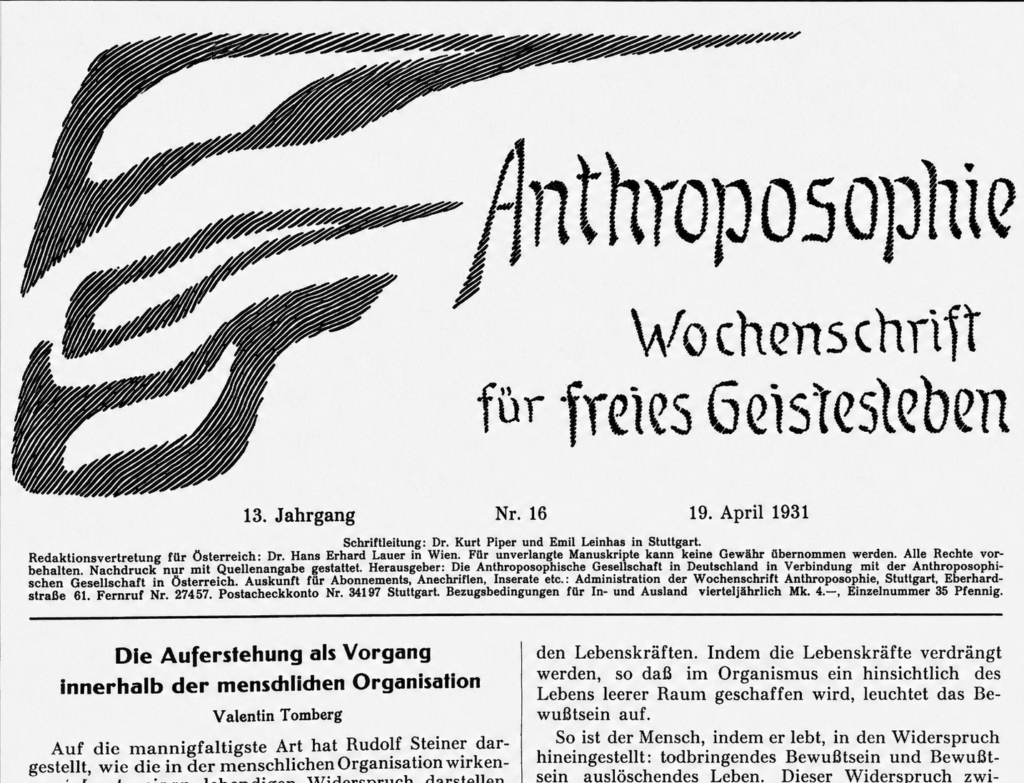
Tomberg wanted to build a bridge from Russian spiritual life to Anthroposophy, but also to awaken an understanding of Russian culture in Central Europe. To this end, in 1930 and 1931 he wrote thirty-two important articles for the German journal Anthroposophie, published in Stuttgart.
During the class lessons of the Free School of Spiritual Science, read by Marie Steiner in Helsinki in July 1931 Tomberg had a profound spiritual experience, about which he wrote to her on July 12, 1931:
“I experienced an awakening of the soul that I could hardly have expected. With my whole soul I have heard the meditation texts that you have spoken in the hall. And everything that they contained I was able to experience this time with all the inner movement of the soul, with all the radiance of the soul. Space disappeared from my consciousness, I lost myself, and instead of both the outside world and myself, a vibrating, radiant majestic experience descended like a mighty wedge of spirit that was both a piece of the world and a piece of man.”
The conference for Russian members of the School of Spiritual Science held in Dornach in August 1931 brought Tomberg his first criticism. Nikolai and Maria Belozvetov believed the Orthodox Church was a vessel for Anthroposophy. Tomberg had apparently supported this view with arguments of his own. In April 1932, Tomberg was back in Berlin with Nikolai and Maria Belozvetov, whose marriage had ended earlier. On May 28, 1932, he wrote to Marie Steiner that he intended to marry Maria Belozvetov, and, after the summer, to study law in Berlin.
On September 25, 1932, Tomberg was elected President of the Estonian Anthroposophical Society and put in charge of the class lessons. Maria Belozvetov moved to Tallinn in the autumn of 1932. She did not have the sympathy of Marie Steiner, so that her connection with Valentin Tomberg came to an end. From the winter of 1932/33, Tomberg worked together with Maria Belozvetof and they married. Their son Alex was born in 1933 and baptized in the Greek Orthodox Church in Tallinn.
As Rudolf Steiner had indicated people would begin to experience the Second Coming of Christ in the etheric sphere of the Earth in the early 1930’s. Tomberg did so and often spoke about the importance of the etheric return of Christ.
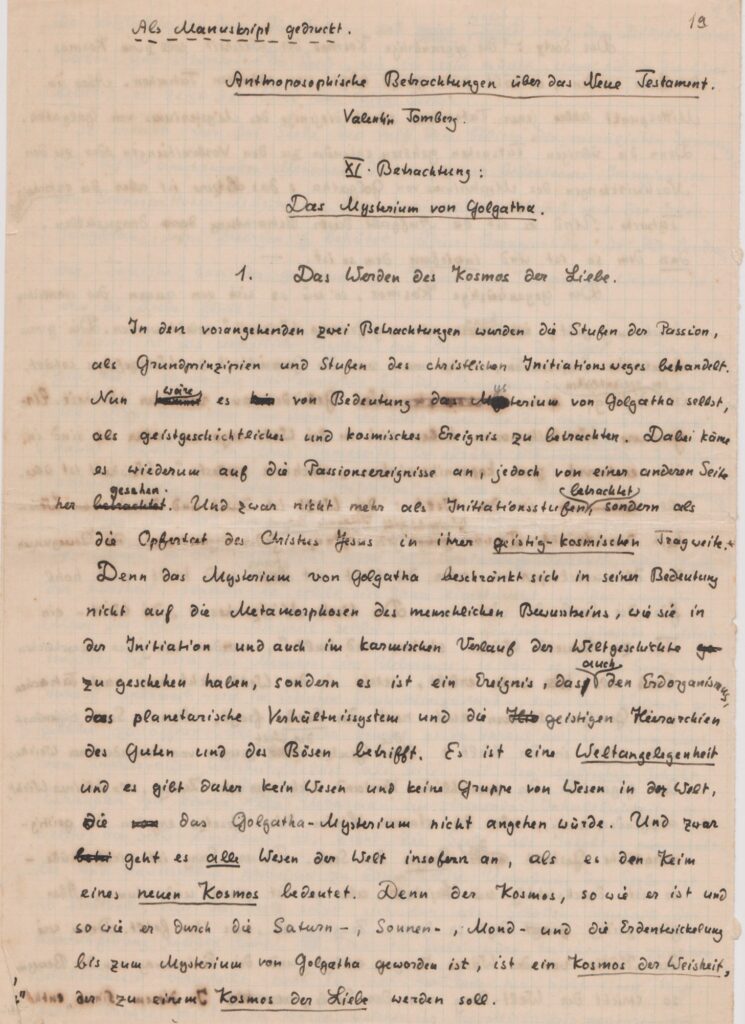
The spiritual cooperation between Valentin and Maria that had begun in the fall of 1932 led further into a thorough study of the Bible. The first fruits of this research were originally published as Anthroposophical Studies of the Old Testament, which appeared in installments from November 1933 onward. His independent research, however, brought him new criticism from Marie Steiner. But he continued with studies of the New Testament and the Apocalypse, which were also published.
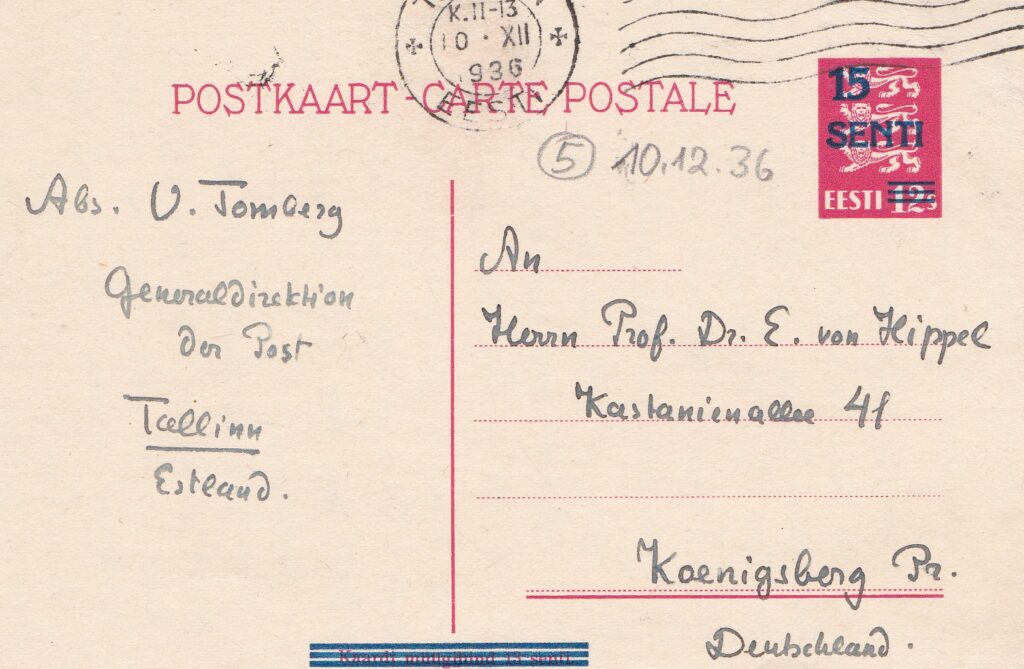
After the crisis in the Anthroposophical Society in 1935 Tomberg established a connection with the excluded “Free anthroposophical groups” that had formed around former Board member Elisabeth Vreede. After writing his book The Foundation Stone, in the autumn of 1936, Elisabeth Vreede made a proposal to Tomberg that altered his destiny. She offered to organize a lecture tour for him. The first tour brought him in the summer of 1937 to Germany, Dornach, England and Holland. On the second tour in the summer of 1938 he visited the same countries. His lectures in Rotterdam on Inner Development were later published. He made friends in Holland, who invited him to settle in Holland, which the Tomberg family did on October 1938. On January 17, 1939, he was officially appointed secretary to the honorary consul of Estonia in Amsterdam.
In Holland Tomberg gave lectures and courses in many towns. Again in Rotterdam he gave a lecture course in August 1939 on “The Four Sacrifices of Christ and the Appearance of the Christ in the Etheric World”, which was published later. The German invasion of the country on May, 10, 1940 prevented him to give public lectures. Also his work for the Estonian consulate came to an end. He now had to rely on the support of his friends, among them Ernst von Hippel, who was a law professor in Köln in Germany. At the end of April or early May he also withdrew from his activities in the Anthroposophical Society at the request of its general secretary, Zeylmans van Emmichoven, who did not agree with the way he was working in Holland. Tomberg belonged to the Christ-oriented Platonic stream, whereas Zeylmans represented the practically oriented Aristotelian stream.
On Ascension Day, May 18, 1939, a new group had emerged out of the circle that had begun studying the gospels with the Tombergs. On January 7, 1940 at the celebration of the Orthodox Christmas feast, Tomberg read to them the Our Mother Prayer, which he had received from the spiritual world. At the age of 40, Valentin Tomberg started to work with a small group of friends from different Dutch towns who considered him their spiritual teacher. Beginning in May or June 1940 they gathered in the home of Valentin and Maria Tomberg in Amsterdam for an esoteric course on the Our Father Prayer. This course lasted for ninety-seven evenings until February 2, 1943, when the war circumstances made the further work impossible.
During these years Tomberg became critical of Anthroposophy, not of Rudolf Steiner, whose spiritual work he held in high esteem until he died. He came to the conclusion that the anthroposophical movement had failed and that its impulse had been ineffective, as he told his friend Bernhard Martin on August 19, 1944.
In the autumn of 1941 Tomberg met the priest of the Russian Orthodox congregation in Holland, whose Church services Valentin and Maria Tomberg attended. After a dispute on reincarnation they withdrew from his congregation in the spring of 1942, but not from the Orthodox Church. Tomberg began to study the Christian tradition—more specifically, the spiritual aspects of the Catholic Church.
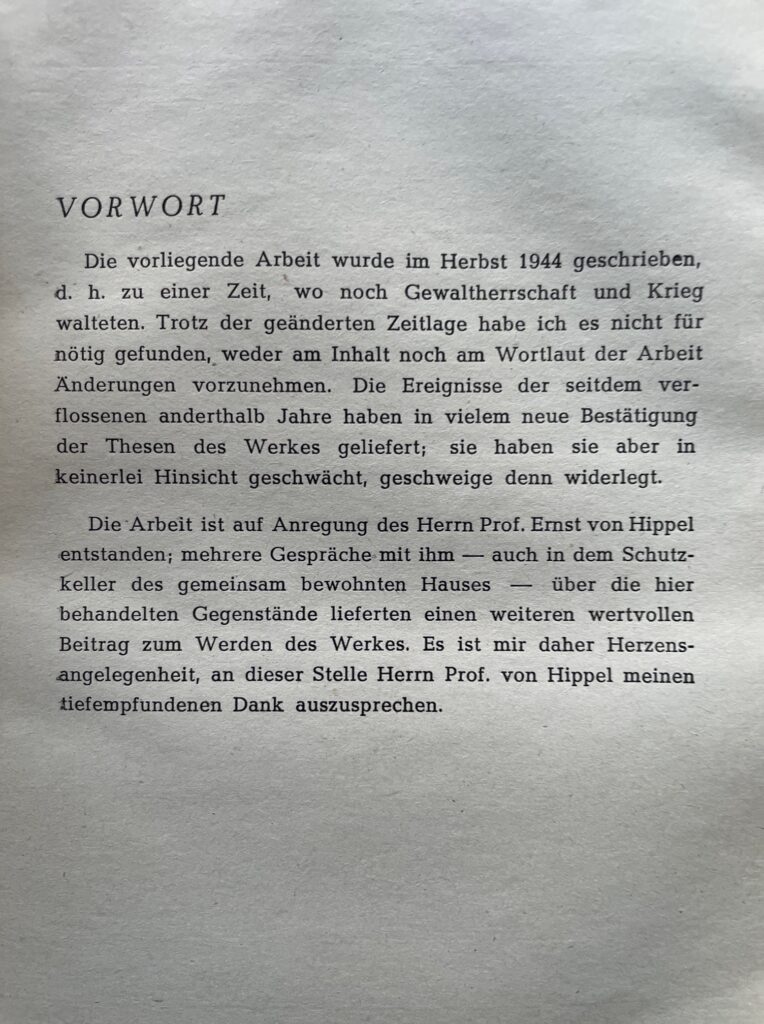
In the last years of the Second World War, Tomberg was in a very difficult situation. His friend Ernst von Hippel invited him to come to Bad Godesberg, near Köln in Germany, where he would have the possibility to finish his earlier law studies in Estonia with a dissertation. The Tomberg family left Holland in February 1944. In the same year Tomberg defended his PhD thesis The Degeneration and Regeneration of Law in Köln and started to work on a second book The Fundamental Principles of International Law as a Law of Humanity, which was completed in 1945.
At the beginning of March 1945, British-American troops took Köln. The foreign forced laborers were soon gathered together for repatriation. The British army set up a camp near Köln, where in mid-July 1945 Tomberg took on a new task in connection with this work of repatriation. He moved there with his family, working as an interpreter in the British service. Maria was also involved in this work.
In the second half of 1945 Tomberg entered the Catholic Church. As a Greek Orthodox he did not have to be baptized. He had been impressed by the resistance within the Church against Nazism. In a note, Eva Cliteur wrote on April 18, 1985, that Ernst von Hippel had told her: “Tomberg was permitted to receive communion in both Churches,” i.e., in both the Greek Orthodox Church and the Roman Catholic Church. As a child Tomberg had been baptized Protestant. He thus united the three Churches in his own person, and in so doing linked himself, we could say, with the original, “undivided” Church, what we might call the Ecclesia universalis, the Universal Church, or as the Russian philosopher Vladimir Solovyov called it, the religion of the Holy Spirit.
At the end of 1945 the Tomberg family moved to Mülheim, where they worked under difficult conditions in a camp set up for Russian prisoners of war. In February 1946, Tomberg became involved in the British reeducation programs that aimed to bring democracy back to political life in Germany. To this end, he was asked to set up and run a center for adult education in Mülheim. Here he organized and led evening courses for adults. In October 1946, Tomberg received a lectureship in ethics and law at the Technical University in Aachen, Germany, where he taught four hours a week.
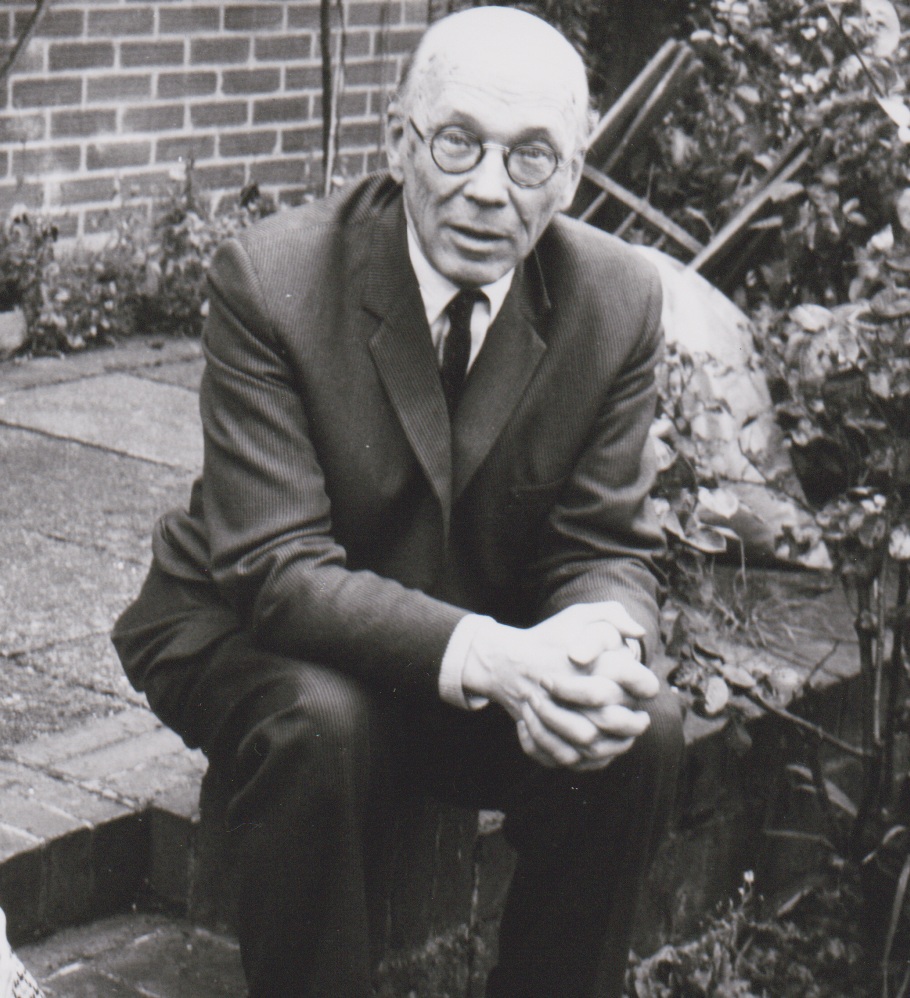
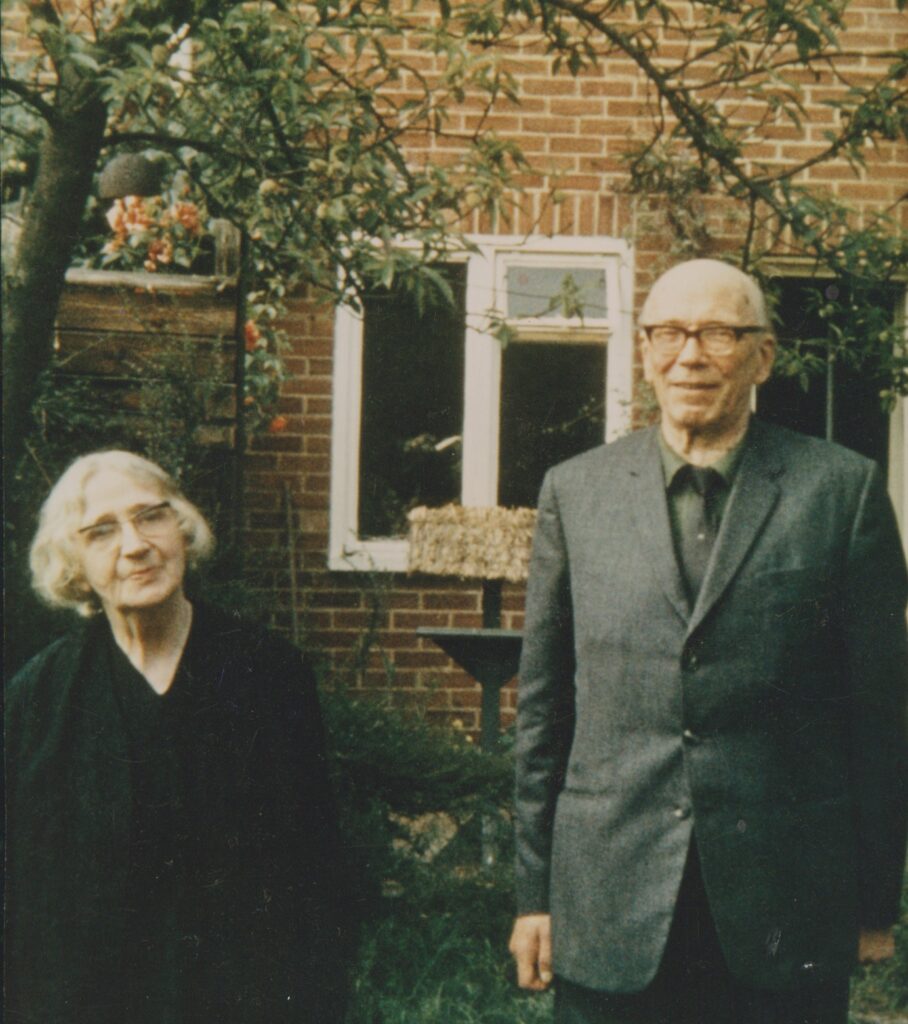
To the great surprise of his friends, Tomberg emigrated with his family to England in 1948. He resigned from both the adult education center in Mülheim and the university in Aachen, and left Germany on July 22, 1948. In further explanation, he later wrote (February 1, 1950) to Ernst von Hippel that he could no longer stay in Mülheim because he felt there was no place for him there, and he knew now that he would always remain a foreigner in Germany.
It was not until early May of 1949 that he found a job at the BBC in Reading, west of London, where his task was to monitor news reports from the Soviet Union, mainly Russian and Estonian. Important radio broadcasts had to be translated and dictated simultaneously so that their contents could be typed out promptly. Other news items had to be summarized. He retired from the BBC in 1962.
After concluding his studies in law, Tomberg entered a new phase in his life, lasting from the end of 1952 until 1959. During this period he lived through a crisis arising out of the question of how one finds personal, inner certainty. In 1955 Tomberg engaged in a holism or integral “synthesis” of the methods of knowledge. This search gave him the idea for a book that would summarize his forty-year quest for truth, but the book was never finished.
In October of 1958, Valentin and Maria Tomberg took a trip to the south of France, which proved pivotal for his new project of presenting Christian mystery wisdom, not as a science but as personal experience. In France, Tomberg rediscovered the living Hermetic tradition, which he had first encountered in St. Petersburg in 1917. By the time he returned from France, it had become clear to Tomberg just how he should proceed. In effect, from 1959 to 1967 he worked as a spiritual researcher in the service of the Hermetic tradition, while writing his magnum opus Meditations on the Tarot. He wanted to have it published anonymously, as happened with the first French German editions.
After the completion of Meditations in 1967, years followed in which Valentin and Maria Tomberg were plagued by illness. Nevertheless his work on Christian esoteric themes continued. Tomberg had already early 1967 finished a text on “The Three Kingdoms” (of Nature, Man, and God). He wrote a book centered on the theme of “The Miracle of the Resurrection of Lazarus in World History,” completed in 1970. A third work, “The Proclamation on Sinai,” was completed in May 1972. Toward the end, Tomberg began another new work, which he called “The Breath of Life,” but did not live to finish.
His friend Ernst von Hippel and his wife invited Valentin and Maria Tomberg to spend a holiday together on the island of Majorca (Spain). They arrived there on January 3, 1973. On February 9, Maria suffered a slight stroke that paralyzed her left side. She was to be flown back to England, but on the 13th, Valentin suffered a fainting attack and a cerebral infarction, causing paralysis on the left side. He died in Palma hospital on February, 24, 1973, and was buried four days later. Maria was flown to England on March 4th, where she died just over two weeks later in Reading on March 23, 1973.